
Single-sided circular weave
This type of fabric is soft and light, and due to its flexibility and high breathability, it is an ideal choice for sewing T-shirts, casual clothes and homewear. Its good contact with the skin and its soft feel are among the outstanding features of this fabric.
Double-sided circular weave
It has a double-sided texture, is resistant and durable, and is very suitable for producing everyday clothing such as blouses and pants. The good elasticity of this fabric makes it show the body shape well. The possibility of using colored threads to create various designs adds to the attractiveness of this fabric.
Double-thread circular weave
A thicker fabric than single-sided and double-sided types, which is produced in plain or stretchy form. Its dense texture is a suitable option for cool seasons such as autumn and is mostly used in the production of clothing such as blouses, sweatshirts and hoodies.
Three-thread dorsa circular weave fabric
It is the thickest type of dorsa with a soft and fluffy inner layer that is used specifically for the production of winter clothing. In addition to the desired warmth, this fabric is also very durable.
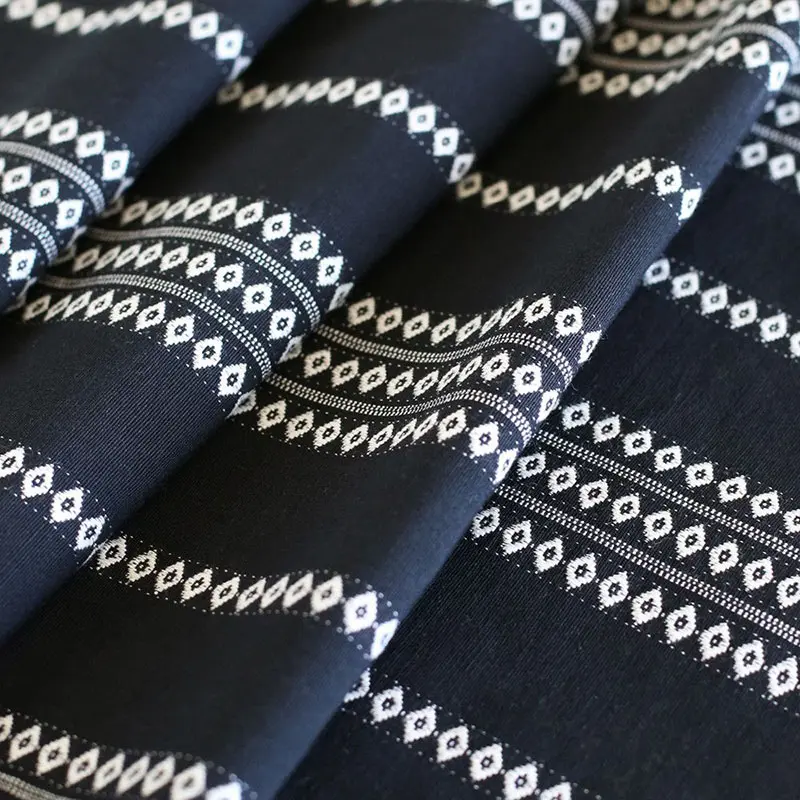
Jacquard circular weave fabric
With its complex texture and prominent designs, this fabric has a stylish and special look and is suitable for formal or decorative clothing such as jackets, skirts, coats and trousers. Jacquard is produced in different weights and can be used in all seasons.
Printed circular weave fabric
This fabric is produced using diverse and colorful printed designs on a variety of thin or thick fabrics. Its usability in four seasons and high variety in design make it a suitable choice for a wide range of clothing.
The process of producing knitted fabric is carried out using circular or flat loom machines and, due to its circular structure, produces a flexible, stretchy and soft fabric that is used in apparel, home textiles and industrial applications.
Fiber preparation
Fiber selection: The process begins with the selection of fibers (cotton, polyester, viscose, elastane, bamboo or their blends). For example, adding 5-10% elastane to cotton increases the elasticity of the fabric.
Cleaning and carding: The raw fibers are washed and cleaned of impurities. They are then arranged in parallel with a carding machine and sometimes combed to remove short fibers and improve quality.
Spinning
Yarn production: The fibers are spun into yarn, usually using ring or open-end spinning methods. The yarn count (such as 20s or 30s) is adjusted based on the type of fabric (such as jersey or rib).
Yarn preparation: Yarns may undergo additional processes such as mercerization (for cotton) to increase strength or softness.
Circular knitting
Circular knitting machines: Circular knitting machines or flatbed knitting machines are used. Circular knitting machines produce tubular fabrics, while flatbed knitting is suitable for flat fabrics or special pieces (such as seamless garments).
Weave types: There are two main types of weave:
- Weft knitting: Such as single jersey or double knit, which have high elasticity and a simpler structure.
- Warp knitting: Such as tricot or rachel, which are more stable and less prone to unraveling.
Machine settings: The number of needles (Gauge) and the diameter of the machine cylinder (for circular knitting) determine the density and thickness of the fabric. For example, a 28 gauge machine is suitable for thin fabrics such as T-shirts.
Initial finishing
Washing: The fabric is washed to remove impurities and knitting oils.
Heat setting: For fabrics containing polyester or elastane, a heat setting process is performed to maintain the dimensions of the fabric and prevent shrinkage.
Dyeing and printing
Dyeing: The fabric can be dyed uniformly (Piece Dyeing) or at the yarn stage (Yarn Dyeing). Reactive dyes are common for cotton and disperse dyes for polyester.
Printing: Rotary or digital printing is used for complex designs (such as fashion clothing).
Softening: Chemical or enzymatic softeners are applied to increase the softness and comfort of the fabric.
Finishing
Finishing: Processes such as brushing to create a pile surface (e.g. fleece) or calendering to smooth and shine the surface of the fabric.
Shrinkage control: Processes such as compacting are applied to reduce shrinkage of woven fabrics.
Quality inspection: The fabric is checked for texture defects, color uniformity, and elasticity.
Cutting and packaging
Cutting: Circular tubular fabrics may be cut to form a flat surface, except in cases such as seamless garments.
Packaging: The fabric is packaged in rolls or cut pieces for specific applications (e.g. T-shirts or fitted sheets).
Expert Tips
Modern technologies: Advanced circular knitting machines allow for the production of seamless fabrics, which are very popular in sportswear and underwear.
Standards: Standards such as Oeko-Tex or GOTS (for organic fabrics) are met to ensure safety and environmental sustainability.
Advantages of circular knitting: High flexibility, stretch and comfort, but may be prone to pilling or deformation compared to flat knitting.
Applications: From T-shirts and sportswear to stretch sheets and technical textiles (e.g. filters).